
People & Power Collection
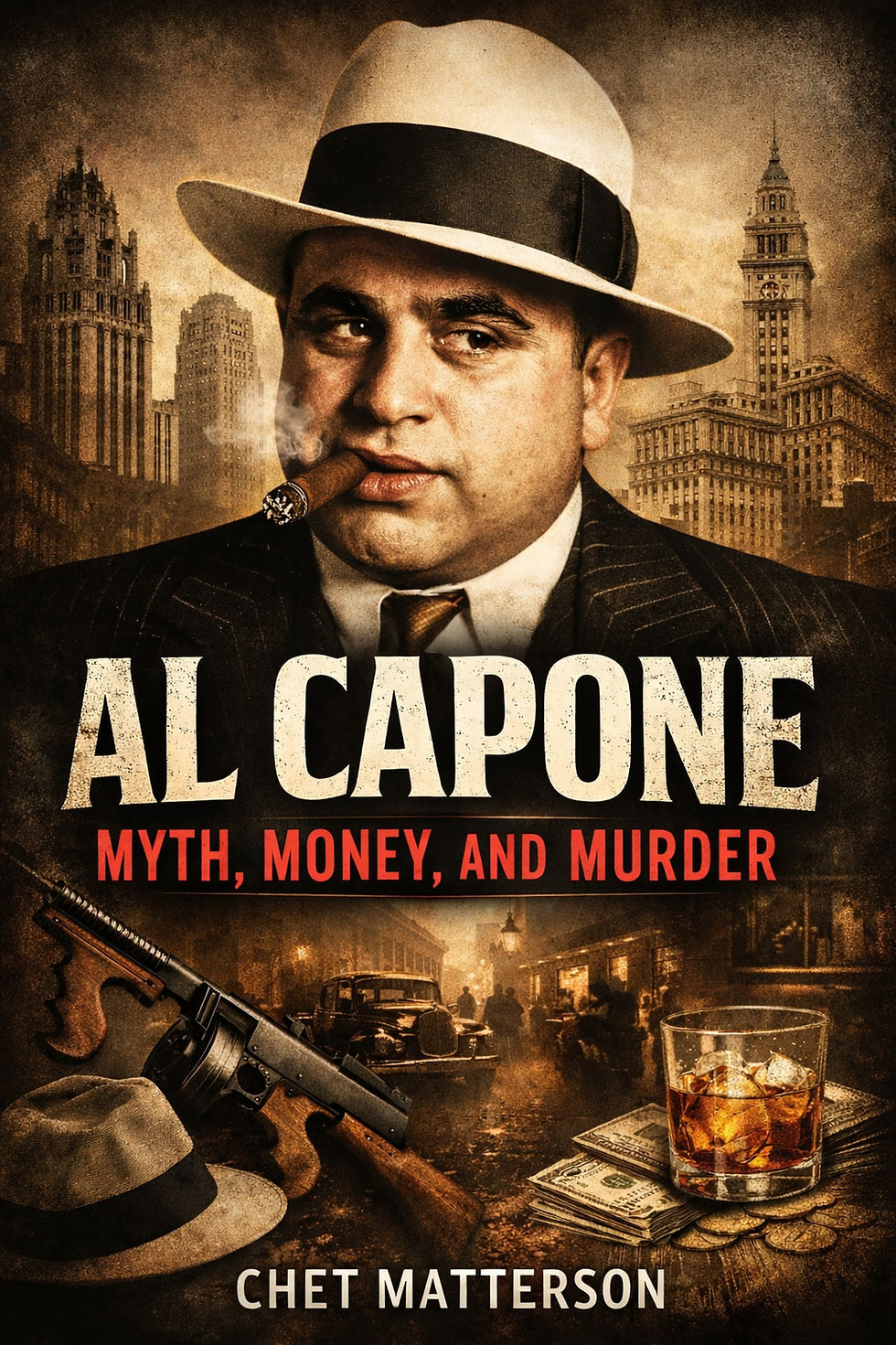
Al Capone: Myth, Money, and Murder
Al Capone: Myth, Money, and Murder separates legend from documented history.
For nearly a century, Al Capone has been portrayed as criminal mastermind, ruthless gangster, and larger-than-life villain of the Prohibition era. Hollywood dramatized him. Headlines sensationalized him. Popular culture simplified him.
But what does the record actually show?
This book examines Capone’s life from Brooklyn tenements to Chicago’s bootlegging empire, from federal courtroom to Alcatraz prison, and finally to quiet decline in Florida. It measures his wealth realistically. It evaluates his violence proportionally. It challenges the mythology that has overshadowed documentation.
Inside, you’ll discover:
• How Prohibition created the economic conditions for Capone’s rise
• The structure behind Chicago’s bootlegging operations
• The truth behind the St. Valentine’s Day Massacre
• Why tax law—not gunfire—ended his empire
• What Hollywood exaggerated—and what history confirms
This is not a sensational retelling.
It is a disciplined historical examination.
Legend persists.
Record remains.
If you are interested in American history, organized crime, Prohibition, or the difference between myth and fact, this book provides clarity where spectacle has long dominated.

Ponzi Scheme: Fact or Fiction
PONZI SCHEME is not a biography of a man.
It is an examination of a mechanism.
Charles Ponzi’s name has become shorthand for financial fraud, yet the structure that bears his name did not disappear with him. It has repeated across generations, technologies, and markets—often in plain sight.
This book traces how a promise becomes a process, how a process becomes a machine, and why that machine continues to work long after its logic has failed. Moving deliberately from Ponzi’s rise through collapse, consequence, and legacy, Ponzi Scheme separates documented history from narrative reconstruction in every chapter, making clear what is known, what is inferred, and why the distinction matters.
Rather than asking who was fooled or who was greedy, this book asks a harder question: what allowed a system that could not work to function for as long as it did?
Clear-eyed, methodical, and unsensational, Ponzi Scheme explains how trust, routine, and delayed verification combine to create failure that looks like success—until it doesn’t.
This is a book for readers who want to understand not just fraud, but the conditions that make it possible—and persisten

Jim Jones and Jonestown: Myth and Fiction
im Jones and Jonestown: Truth and Fiction is a careful examination of one of the most misunderstood tragedies in modern history.
Rather than retelling the event through shock or spectacle, this book traces how Jonestown developed over time—how authority consolidated, dissent was silenced, institutions hesitated, and myth replaced evidence. Drawing on survivor testimony, historical records, media analysis, and institutional context, it separates what is known from what has been repeated without examination.
This is not a sensational account, nor a psychological profile written in hindsight. It is a work of historical nonfiction focused on process rather than legend, and understanding rather than judgment.
The book challenges the familiar narrative of collective fanaticism and replaces it with a clearer picture of coercion, control, and structural failure. It restores humanity to those who died, centers survivor experience, and examines why Jonestown continues to be remembered inaccurately decades later.
Written in a measured, traditional historical style, Jim Jones and Jonestown: Truth and Fiction is intended for readers seeking clarity rather than comfort, and understanding rather than mythology.

Gen Z: Truth vs. Fiction
Why does every generation believe the next one is broken?
From claims that Gen Z is lazy, weak, distracted, and addicted to validation to fears about technology, loneliness, cynicism, and collapsing community, modern culture is filled with anxiety about the future. But are these problems truly unique — or part of repeating historical patterns?
This book explores the deeper forces shaping modern life:
-
social media and attention fragmentation,
-
institutional distrust,
-
burnout and economic uncertainty,
-
loneliness and declining community,
-
emotional culture and mental health,
-
changing ideas about work, family, and identity.
Rather than offering outrage or blind optimism, the book examines how history, technology, culture, and human psychology interact to shape each generation differently.
Inside, you’ll discover:
-
why cynicism became fashionable,
-
how digital life changed attention and relationships,
-
why younger generations distrust institutions,
-
what previous generations misunderstood about youth,
-
and how stability, meaning, discipline, and community can still be rebuilt.
Balanced, reflective, and historically grounded, this book argues that no generation is permanently doomed. Every generation inherits both strengths and damage from the generations before it — and the future depends on whether people choose only to criticize what they inherited or learn how to rebuild what was lost.
Perfect for readers interested in:
-
generational change,
-
modern culture,
-
psychology,
-
technology and society,
-
social commentary,
-
and personal responsibility in uncertain times.